
Facial Recogniton Programs Know Whether You're Liberal or Conservative
Also: E.O. Wilson, John Cleese, and Will Blank Slate Theory Ever Die?

You don’t have to tell us what you believe. We already know by your face.
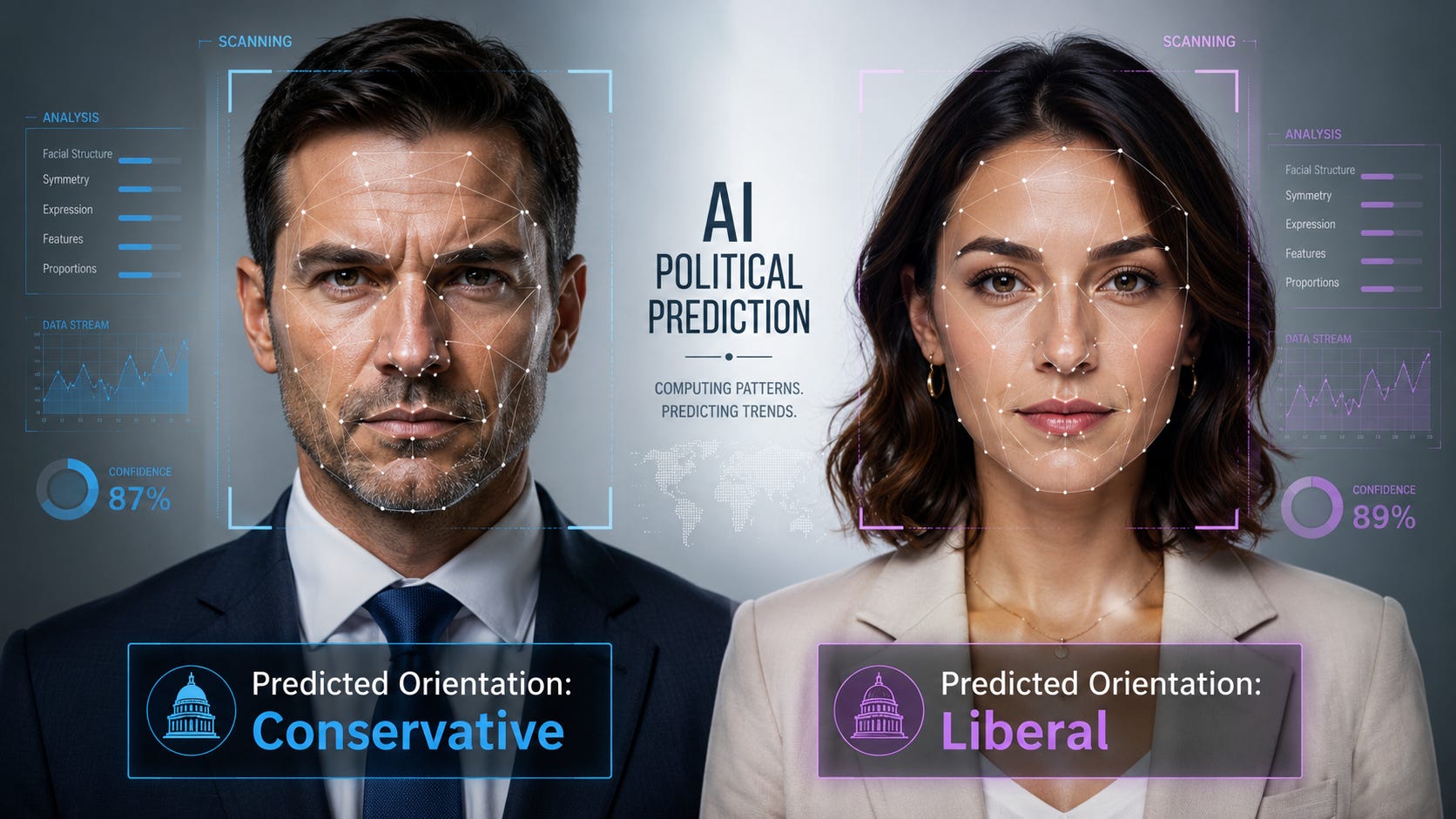
At least, a facial recognition program seems to be able to detect people’s politics to a degree far greater than chance.
Previously, I published a post that seeks to explain all things political. Specifically, I explore three main features of Homo sapiens—features we share with primates and other territorial mammals—that explain the vast majority of all ethnic conflicts, revolutions, wars, politics, and civilization trends.
But one part of the post discussed a 2021 study, published in Nature, whose title reveals its important conclusion: “Facial recognition technology can expose political orientation from naturalistic facial images.” The article did receive not-unexpected pushback—as have all such discoveries over the last fifty years that heap still more dirt on the grave of blank-slate theory. I discuss some of the counter-arguments below, and show that another study, also published in Nature, has replicated its findings in 2023.
But importantly, the larger point I was trying to make is that, in general, we should think of differing political beliefs not as ideas that spring from conflicting rational analyses but as beliefs that naturally find residence in different types of people. They are personality-dependent. They are disposition-driven.
Consider John Cleese’s discussion below about politics and extremism in early-1980s England:
Notice how Cleese’s two warring political groups closely match their counterparts in the United States today. And, specifically, the pair of political parties in Cleese’s England of 40+ years ago have essentially the same resentments that we find in present-day America.
Cleese’s List of the Enemies of the Left: “Almost all kinds of authority, especially the police, the city, Americans, judges, multinational corporations, public [i.e. private] schools, furriers, newspaper owners [i.e., of right-wing papers], fox hunters, generals, class traitors and, of course, moderates.”
Cleese’s List of the Right’s Enemies: “noisy minority groups, unions, Russia, weirdos, demonstrators, welfare sponges, meddlesome clergy [who tended to be liberal], peaceniks, the BBC, strikers, social workers, communists and, of course, moderates … and upstart actors.”
In other words, the English left of that time distrusted the wealthy elites (and their conservative supporters) — while the English right opposed the other, i.e., minorities, Russia, “weirdos,” etc., (and their leftist supporters).
So any effort to explain the current political divide in the United States by pointing at topical events, whether blaming social media, Trump, inflation, the border, misinformation, etc., is necessarily misguided or at least woefully incomplete. Yes, it is possible that, at times, current happenings exacerbate political extremism, spur social movements, or result in shifting political alliances. But in terms of this omnipresent right vs. left divide, we must seek explication in the universal traits of the human race.
Your Face and Your Political Views
As I noted above, a considerable amount of evidence for the non-intellectual basis of politics has accumulated over the years. For example, a 2021 report in Nature confirmed that facial recognition technology can expose your political leanings with remarkable accuracy.
Quoting the article: “Political orientation was correctly classified in 72% of liberal–conservative face pairs, remarkably better than chance (50%), human accuracy (55%), or one afforded by a 100-item personality questionnaire (66%).”
The algorithm was even surprisingly accurate in predicting political views when they controlled for gender, age, and ethnicity.
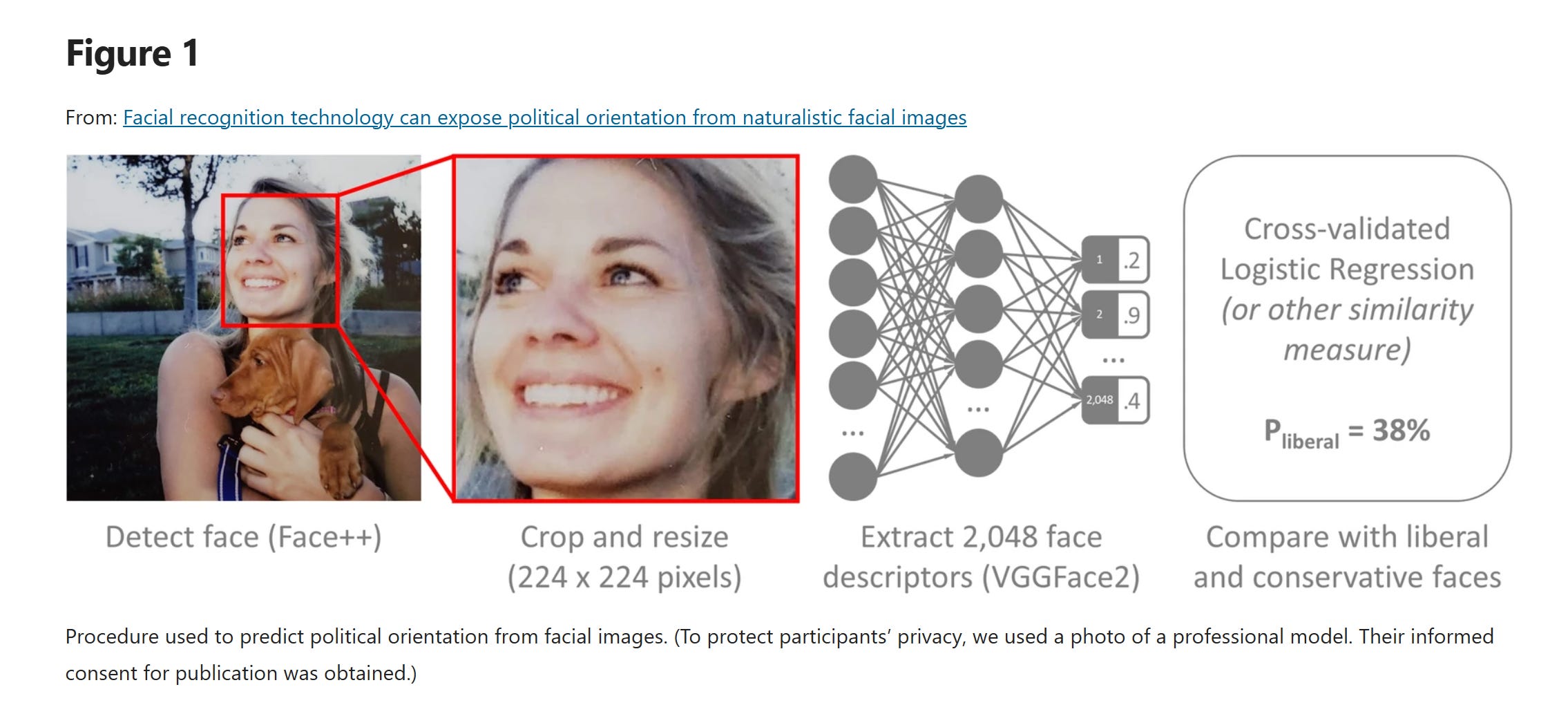
Kosinski points out in his notes on the article: The experiment has been independently replicated.
Why would political views correlate with certain facial features—or have anything to do with genetics? Well, first of all, let us first understand, everyone knows that aggression, violence, and criminality are highly correlated with a certain group of genes. Indeed, roughly 90% of murderers and 99% of rapists share the same chromosome—a group of genes that is absent in roughly half the population: the Y chromosome. In other words, rapists are far less likely to have female faces.
And don’t we know why this is? For isn’t it also true that high levels of testosterone is one of the culprits in criminal behavior? And isn’t it also true that high testosterone is related to certain masculine facial features—as noted here and here? And most of us even instinctively know what facial features are linked to high-testosterone — more defined jaw, larger facial width-to-height ratio—you know, Connor Fucking McGregor.

So while of course criminality will correlate with myriad variables, both environmental and innate, wouldn’t it seem reasonable that, at the very least, more masculine facial features have a higher correlation with violence than more feminine facial features? That’s not 19th-century phrenology. That’s just walking around Earth with your eyes open and accepting obvious realities.
It also seems likely that many other facial features might also reflect a potential for criminality—a conclusion that is consistent with a few recent studies. To quote one such study by Jeffrey M. Valla, et al.:
Participants, given a set of headshots of criminals and non-criminals, were able to reliably distinguish between these two groups, after controlling for the gender, race, age, attractiveness, and emotional displays, as well as any potential clues of picture origin.
Again, a recent work from the University of China showed that, in the words of MIT Technology Review, “Neural Network Learns to Identify Criminals by Their Faces.” And quoting the conclusion of the article:
If humans can spot criminals by looking at their faces, as psychologists found in 2011, it should come as no surprise that machines can do it, too.
And can’t we make similar arguments about political bent? Isn’t it also obvious, for example, that high-testosterone correlates with conservative views? Or to put it in the provocative words of the title of a Vice article: “Gym Bros More Likely to be Right-Wing Assholes, Science Confirms” — or as described by a less-strident article title on the same study: “Muscular men less likely to support social and economic equality, study suggests.” In fact, the relationship between testosterone and political leanings is so marked that, stunningly, the use of a testosterone-laced gel resulted in a tendency of weakly affiliated Democrats to shift to the right politically.
And come on. Deep down, don’t we all know this? Do we really think it is a coincidence that while the vast majority of actors in Hollywood are left of center, most of the male action heroes — Bruce Willis, Arnold Schwarzenegger, Chuck Norris, Clint Eastwood—tend to be to the right politically?

Regardless, Kosinski’s finding is consistent with the notion that, in many people, political inclinations are not really rational conclusions deduced from observations—but simply identify a type of person. After all, how certain can we be that we have objectively concluded something when a facial recognition program can predict from the face we were born with what we have already concluded?
Blank Slate Soldiers Still Fighting a Lost War
Now, of course, for the last sixty years, almost every discovery suggesting any sort of role for genetics in various features of human behavior, capacities, attitudes, etc, has caused considerable uproar. That is because it conflicts with what many professors in the social sciences and the humanities really want to believe and had taught throughout much of the 20th-century: Blank Slate theory—the notion that directly behind our eyes it’s all tabula rasa, and all differences in human output are exclusively the result of societal imprinting. More, many in the social science fields have claimed that any claim to the contrary—any hypothesis, theory, conclusion, observation, or empirical result suggesting even a hint of nature to go along with all the nurture—was just part of an effort to revive long-discredited racist theories that sought to preserve the patriarchy.
In reality, it’s the tabula rasa theory of human nature that has suffered repeated falsifications. For further study on this issue, I highly recommend Steven Pinker’s powerful book, The Blank Slate: The Modern Denial of Human Nature (2002)—a work that thoroughly dismantles the politically-inspired empty-vessel view of the human brain. Pinker not only shows why it’s wrong, but also explains why the adherents’ fears of allowing genetics to play some role in human behavior—fear of inequality, imperfectibility, determinism, nihilism, etc.—are all unfounded.
Even more recently, do get Steve Stewart-Williams’ latest book, A Billion Years of Sex Differences: How Evolution Shaped the Minds of Men and Women. That is next on my reading list, but as is clear from the excerpts that Stewart-Williams has posted on his Substack, this is a sober, fun, brilliant, and comprehensive work, filled with important insights and interesting tidbits. And, of course, it has the added virtue of being true.
Still, like Hiroo Onoda, the Japanese second lieutenant who continued fighting World War II into 1974, many blank-slate soldiers are battling on. To take one infuriating example, in late 2021, Scientific American published a highly critical “eulogy” of E.O. Wilson, one of the most important scientists of the last century. Wilson was an all-around naturalist — an entomologist, biogeographer, and Pulitzer Prize-winning author of On Human Nature and The Ants. One of his most important books, Sociobiology: The New Synthesis, would inspire the revival of evolutionary psychology, perhaps the last known intellectual revolution. And, unfortunately, the world has yet to realize the significance of his main contribution to the human race: Consilience: The Unity of Knowledge.
I was especially irritated by the attack in Scientific American because I once had the opportunity to interview E.O. Wilson, and he allowed the conversation to go on for hours. He was a true southern gentleman—a very kind and lovely man, blessed with a sparkling mind. The brilliant Razib Khan, whose newsletter I highly recommend and who was recently interviewed by Richard Hanania on “The Miraculous Findings of Paleogenetics”; wrote a rebuttal to the Scientific American article, providing a more accurate appraisal of Wilson’s accomplishments. Kahn’s article was cosigned by dozens of other scientists.
So according to the Scientific American hit-piece, what were some of Wilson’s sins? Well, one problem is that he often wrote that ants liked to hang around in “colonies” — as in colonization—you know, because he’s a Klansman. But his most unforgivable act was that in Sociobiology, he pointed our that our brains are the product of evolution. So just as we can better understand the behavior of ants, bees, chickens, lions, wolves, raccoons, etc., from an evolutionary perspective, the same is true for people. And for the sin of writing this in the 1970s, Wilson has been repeatedly attacked as a racist ever since, including in Scientific American right after he died.
As I have read many dozens of such critiques of evolutionary psychology (or its various corollaries), I know they are all pretty much the same. They rarely address the specifics of the theory; instead, they combine moralistic and association fallacies, especially making value judgments about the idea and decrying it as “ethically problematic.” In almost every case, they strive to discredit the idea by linking it to certain antiquated viewpoints and long-dead scientists they deem heretical and repugnant.
These critiques so closely follow the same template that they almost always use the same terms and reference the same boogie men. We can even create a Blank-Slate-Hit-Piece score by assigning points to the use of certain words—say, one point for each use of eugenics, phrenology, discredited, debunked, junk science, pseudo-science, calipers, craniographs, slavery, colonialism, Victorian, problematic, questionable, and racist/racism in isolation; 3 points for scientific racism, race science, or social Darwinism; and 5 points for all references to supposedly evil scientists like Francis Galton, Cesare Lombroso, etc. Applying this metric to the Scientific American essay against E. O. Wilson, they earn a whopping 25 points for their Blank-Slate-Hit-Piece score.1
Want to Become More Objective? Identify Your Political Type and Then Try to Reason Against Your Biases
I understand that few people really want to think that their political beliefs arose from anything other than rational analyses. But let’s face facts: You already know what your political type is. You already know that due to some combination of nature and nurture, you tend to cheer harder for either Team Red or Team Blue.
But the only way to develop a truly accurate and objective view of reality is to understand that your political inclinations naturally tempt you into motivated reasoning, snap judgments, instant dislikes, and unwarranted loyalties. The trick is to stay ever cognizant of these biases and work as hard as possible to assess or even falsify those ideas that are most dear to you.
As physicist and polymath Richard Feynman wrote: “The first principle is that you must not fool yourself and you are the easiest person to fool.” And this is even true—or perhaps especially true—with intellectuals. The fact is: intelligent people are often very good at using their inherent mental agility for extraordinary feats of self-delusion. The trick is to transform yourself from a great lawyer for the defense of your beliefs to a sober and disinterested judge. Put all your beliefs on the witness stand, aggressively interrogate them; and then adjudicate dispassionately.
The article used scientific racism twice (6 points), racist/racism another six times (6 points), problematic seven times (7 points), debunked once (1 point), and Francis Galton once (5 points) for a grand total of 25 points.
Well done. It would be worthwhile to direct ai to use your point system to look at politically motivated editorials in serious science journals, eg science.
"But his most unforgivable act was that in Sociobiology, he pointed out that our brains are the product of evolution." I know Randians and leftists who vehemently reject that. They consider themselves naturalists but still cling to the philosophical dualist notion that mind and body are two distinct substances, and that mind is superior.