
North Meets Shakespeare
"Greene's Groatsworth of Wit" held the key to the Shakespeare mystery
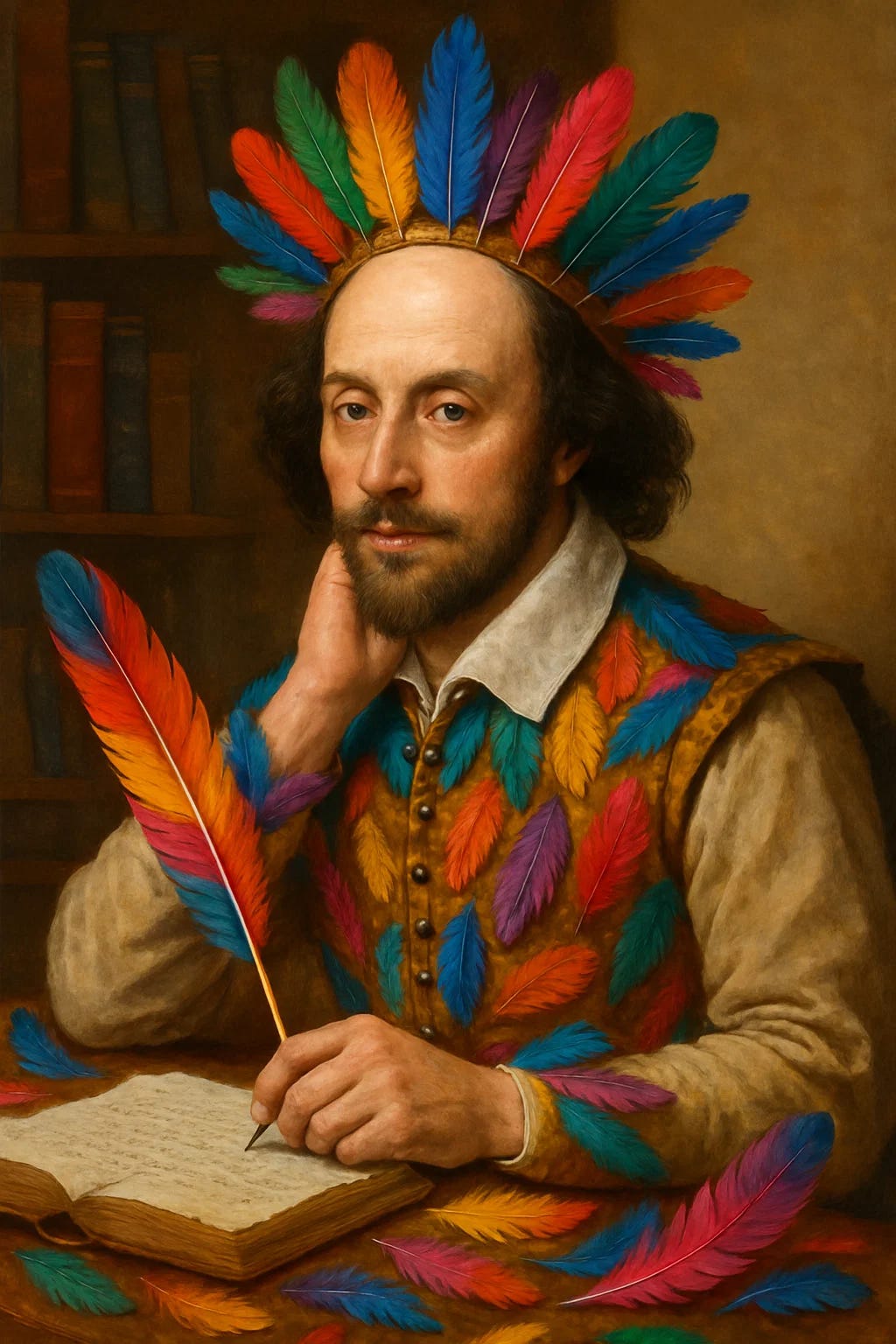
My latest book, North Meets Shakespeare: How a Scandalous 1592 Pamphlet Exposed the Most Important Literary Relationship in History, offers the most comprehensive and definitive analysis yet for Greene’s Groatsworth of Wit (1592). Long familiar to Shakespeare scholars, Groatsworth is a notorious, gossipy tract that derides Shakespeare as a plagiarist, the “upstart crow, beautified” with the feathers of others. Yet there’s far more to the pamphlet than this oft-discussed insult. At its outset, Groatsworth presents a thinly veiled biography of the North family, especially focusing on Thomas’s life and explaining exactly how he came to sell his plays to Shakespeare. North discovery. (To read more, click here.)
In early December, Medieval and Renaissance Drama in England will publish June Schlueter’s and my article confirming that, as with Groatsworth, the satirists Thomas Nashe, Thomas Lodge, and Ben Jonson also identify North as the original author of Shakespeare’s plays—especially crediting him with Hamlet, Romeo and Juliet, Timon of Athens, Julius Caesar, and Much Ado About Nothing. On this paper, we also worked with technologist and writer, Louis Anslow (author of the Pessimists Archive Newsletter), who, in turn, connected us to Archie McKenzie, a computer scientist at Princeton. Under Anslow’s direction, McKenzie created a code he embedded into GPT-3 that uses cosine (or vector) similarity to locate the most similar sentences shared between two texts. This helped expose one way that Lodge identified North as the original author of Hamlet.
Importantly, while these analyses of Shakespeare-era satires are only being published now, Schlueter and I have known about most of these identifications of North for more than a decade. Indeed, many of them (especially involving the works of Nashe and Jonson) are what first led me to the discovery that North wrote the original plays. It was then that I decided to use plagiarism software to compare Shakespeare’s writings with North’s—and was stunned to discover that the two oeuvres share thousands of unique lines and passages. Indeed, no one has borrowed more from an earlier writer than Shakespeare has from North.
This, in turn, inspired June Schlueter, Michael Blanding, and me to search for personal writings of Thomas that were formerly kept at the North family library. This is how we made Shakespeare-related finds that have generated such media attention—including Thomas North’s 1555 Travel Journal (used for The Winter’s Tale and Henry VIII), a 1576 North family manuscript on rebellions (used for 2 Henry VI, King Lear, and other plays), North’s marginalia in his own book of counsel literature—Dial of Princes—which he used as a workbook for Arden of Faversham, The Taming of the Shrew, and Macbeth; and North’s outline to Cymbeline, which he had written into the margins of Fabyan’s Chronicle.
Meanwhile, our research into North’s life repeatedly demonstrated that North didn’t just write the plays, he lived them too—turning the most stunning and dramatic experiences into set-piece scenes of Shakespeare’s plays. See this post for more detail:

But as noted in North Meets Shakespeare, Groatsworth provides an entirely new and independent series of proofs for North’s authorship:
But astonishingly, as North Meets Shakespeare will show, we can throw all this evidence out. We can reject all the thousands of borrowed lines and passages; we can ignore all of North’s friends, family, and lived experiences that inspired some of the most significant characters and striking scenes in the plays; we can burn North’s handwritten travel journal that he used for Henry VIII and The Winter’s Tale; we can scrap North’s workbooks for Shakespeare’s plays and his outline to Cymbeline—and we can start all over and prove from scratch, with an entirely new set of independent facts, that North wrote plays Shakespeare later adapted.
North Meets Shakespeare (Excerpts):
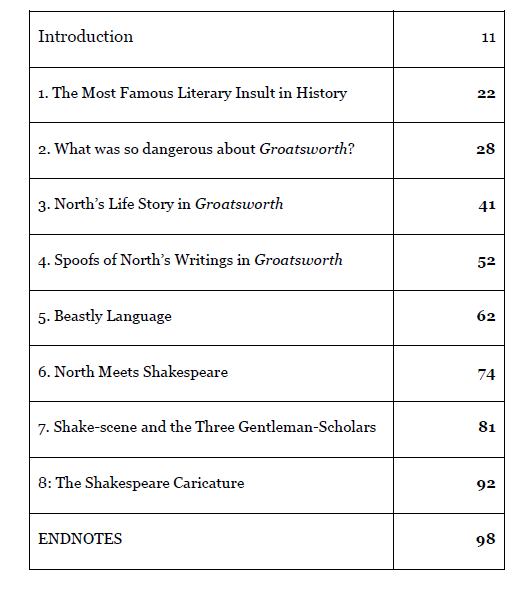
Table of Contents:
Excerpt from Introduction:
For years, my research partner June Schlueter and I have uncovered evidence that turns the Shakespeare story upside down. The plays we know as Shakespeare’s began with another pen—that of Sir Thomas North (1535–1604?), a soldier, translator, and courtly man of letters.
North was nearly three decades older than Shakespeare. He wrote his dramas for the Earl of Leicester’s theater troupe, Leicester’s Men, who performed them before the Queen and at country estates until the Earl’s death in 1588. Shakespeare only entered the scene later, in the 1590s, reshaping North’s scripts for the theaters of London.
So how did Shakespeare get his hands on North’s plays?
The easy answer is the actors. In 1594, five veterans of Leicester’s Men joined Shakespeare to form a new company, the Lord Chamberlain’s Men. Their names still resonate with Shakespeare enthusiasts: John Heminges, who would later help publish the 1623 collection of Shakespeare’s plays—the First Folio; William Kempe, the clown who created the lascivious knight, Falstaff; George Bryan; Richard Cowley; Thomas Pope. These actors had already played North’s Hamlet, Romeo and Juliet, and Henry V. Surely, they brought these plays and others to Shakespeare’s company.
Mystery solved, right?
Not quite.
Contemporary accounts from the time show that Shakespeare met North in person—likely through those very actors. Moreover, these accounts confirm North didn’t just sell him plays; he became his mentor, instructing him in matters of writing, comportment, and even dress. This book examines one such description of North and Shakespeare—in Greene’s Groatsworth of Wit.
As this satire shows, the story of Shakespeare does not start in Stratford; it begins with his first meeting with Thomas North ….
[Get the book by clicking here: North Meets Shakespeare]
Fascinating stuff. I'm actually working on a large Shakespeare project at the moment and this apparent association is one of the more interesting theories I've come across.
The amount there was to say within your narrow focus on this particular satire was revelatory. I'm already a couple weeks out from my first reading of the work, but it seems to me you substantiated your interpretations of the various Groatsworth passages with numerous references to relevant contemporary context, while leaning hardly at all on the other satires you are working with. It turns out you didn't need them to persuasively sustain your case.
About the forthcoming paper, if it substantiates contemporary knowledge of a source play for Julius Caesar, that will by itself be a very significant reshaping of the battle space. Your argument about "Et tu, Brute" having had to have existed in a play prior to 1595 (given in Thomas North, 2022) is surely the most straightforward gloss on the facts, but some will still be able to argue that it merely shows that the line had become oral tradition by then, or even that Shakespeare might have taken the line from True Tragedy.
The problem that the existence of a source play for Julius Caesar will present is that the existing play so closely follows Plutarch's Lives. If Thomas North (or even some other playwright, for that matter) first adapted the play from Plutarch's Lives, and THEN Shakespeare adapted this earlier playwright's play into the current play, then Shakespeare's contribution could have been at best rather slight.
This is why, although they may sometimes acknowledge that Shakespeare frequently used source plays, conventional scholars will have great difficulty acknowledging such a possibility in the specific case of the Roman plays. If some can be brought around on this point, that could be huge.