
Three More Brain-Breaking Mathematical Stunners
All wild and seemingly impossible

My prior article on “Mind-Melting Mathematical Facts” was quite popular:
And I do think that this prior post really provides one of the few common-sense and easy-to-understand explanations for the “boy born on Tuesday” problem.
So here now are three more facts of mathematics that violate our intuitions:
In a room with 23 people, there is about a 50% chance that two people share a birthday.
This seems difficult to believe because there are 365 days in the year—so how could just 23 people give you roughly even odds?
The mistake is that many people think about the odds that their particular birthday might match with 22 others—and, yes, that is still improbable.
But what matters is every possible pair of matching birthdays, and each of the 23 people can match with 22 others, giving:
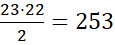
That means there are 253 separate opportunities to match—so you already see it is more than half the number of days in the year.
The easiest way to calculate the exact probability for the problem is to consider the chances that no birthday-match happens.
The odds that the second person to walk into the room does not match the birthday of the first are obviously 364/365. That second person can be born on any other day of the year, except on the first person’s birthday.
The third must now miss the two already taken birthdays: 363/365.
What are the odds that both the 2nd and 3rd person into the room miss all previous birthdays?

The fourth must avoid three birthdays: 362/365
Keep going till 23 people are in the room, and that equals:
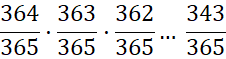
Multiply those together and the probability that all birthdays are different drops to about 49.3%. That means the probability that at least two match is 50.7%.
The birthday coincidence may feel remarkable—but it should happen about half the time.
With 30 people, the probability rises to about 70%;
with 50 people: 97%;
with 57 people: over 99%.
A Shuffled Deck Has (Almost Certainly) Never Existed Before
Take a deck of 52 cards and shuffle it thoroughly.
The exact order you now hold has almost certainly never occurred before in the history of cards. Why?
There are 52 possibilities for the first card, 51 for the second, and so on:
52×51×50×⋯×1 = 52!
That equals: 8.07 × 10⁶⁷
That number is so large it is almost impossible to grasp.
For comparison, the estimated number of atoms in the Milky Way is also on the order of 10⁶⁷.
So a shuffled deck has roughly as many possible arrangements as there are atoms in our galaxy.
Even if every human who ever lived—about 100 billion people—shuffled a deck every second for thousands of years, they would not come remotely close to exhausting this space.
Every non-trivial sentence you speak or write is the first time those words have ever occurred in that order
As Steven Pinker wrote in The Language Instinct:
“Virtually every sentence that a person utters or understands is a brand-new combination of words, appearing for the first time in the history of the universe.”
That is not hyperbole, but another astonishing fact of mathematics.
Of course, we must exclude clichés, quotations, and lexical bundles—phrases that function as units, like “peanut butter and jelly sandwich,” or routine exchanges like “How are you? I’m fine.” But nearly all other sentences are unique. Indeed, most seven-words in a row are unique.
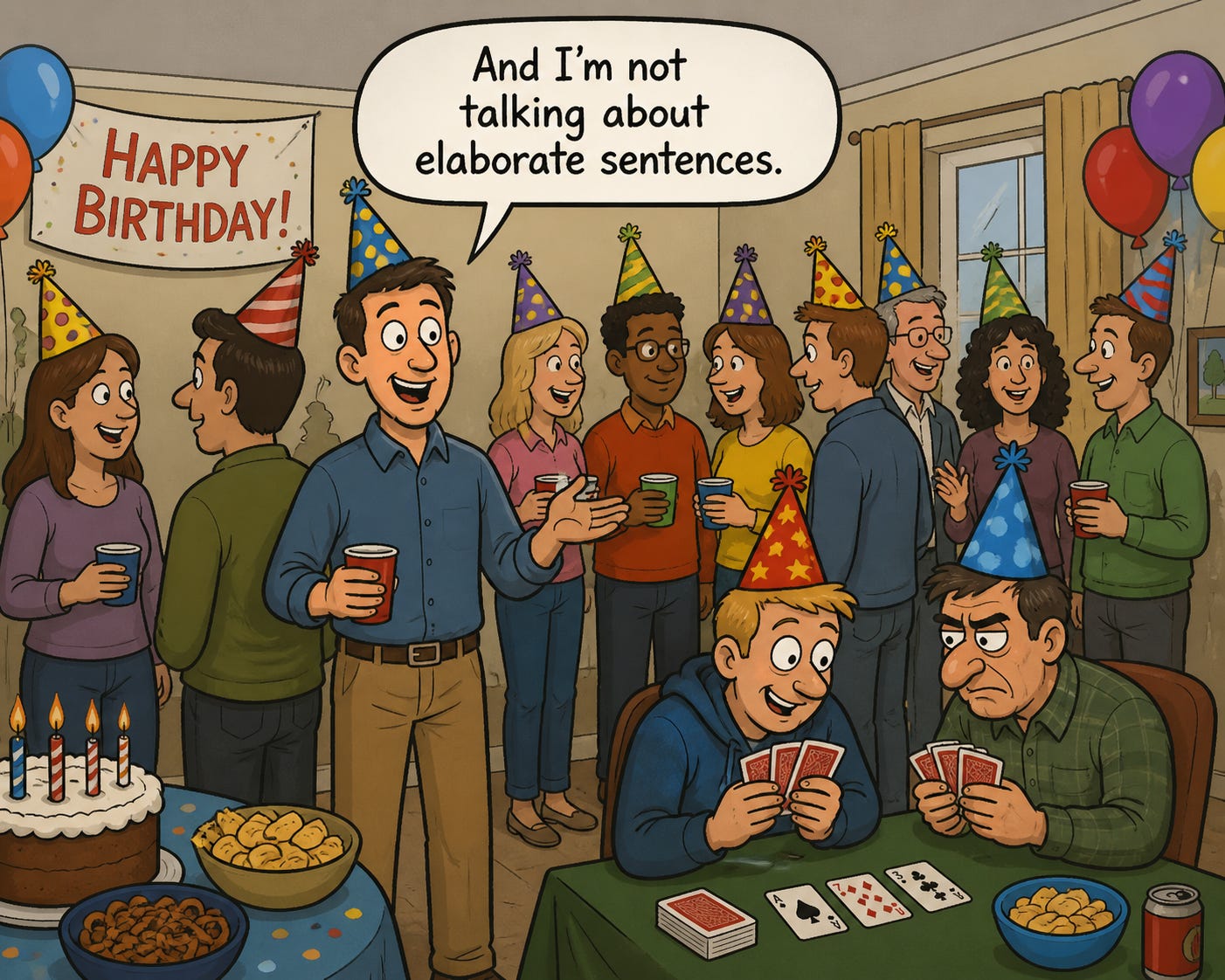
Don’t believe this? You can test this yourself. Take any book. Open to the first page. Type its first seven words (in quotation marks) into Google.
Almost always, you will find only that book—or direct quotations of it. But you are unlikely to find the line has been independently created.
Then check the next seven words and so on.
In an article arguing that Melania Trump’s speech at the 2016 GOP convention was based on Michelle Obama’s 2008 Democratic Convention speech, Megan McArdle makes this same point:
Writers know that it’s unlikely to hit on someone else’s words as closely as Melania Trump’s speech copied Michelle Obama’s. As my friend Terry Teachout once pointed out to me, highlighting as few as seven words of your own writing, and searching them in Google surrounded by quotation marks, which restrict the search to exact matches, is likely to produce exactly one hit: your work. And I’m not talking about elaborate sentences; I’m talking about boring fragments like “And I’m not talking about elaborate sentences.” That search returned no hits when I searched it Monday morning, and will return exactly one after this column is published.1
Why is this?
Well, we saw above how the numbers work with just 52 cards. Contrast this with all of English language, which gives you thousands of content words—nouns, verbs, adjectives—and perhaps a hundred or so function words—the glue: the, and, of, to, in, and so on. Every sentence is a selection from both pools, arranged in a specific order under grammatical constraints.
Take a simple seven-word sentence. Suppose, conservatively, that only and exactly three of those are content words drawn from a pool of, say, 10,000 commonly usable words, and the rest are function words drawn from ~100. So our denominator is already in the territory of:
10,000 × 10,000 × 10,000 (for the content words),
multiplied by 100 x 100 x 100 x 100 for each of the four function word slots
We’re sailing deep into the quintillions here: specifically there are 100 quintillion possible 7-word sequences, which is a one with 20 zeroes. English grammar does sharply narrow the ordering, but even if we don’t consider word order at all—and just try to guess at all the words that occur in a 7-word string, we are taking roughly a shot at 1 in 650 quadrillion.
This is only to get a glimpse of the numbers, and myriad other factors would have to be taken into account. And, yes, normal human experience will often group some words together more than others (e.g., sand, sun, beach or glass, red, wine.) But remember, we are excluding cliches and lexical bundles.
Now Compare This Number to Human Output
How many Modern English sentences have actually even been produced?
About 700–900 million highly fluent English speakers today
Around 6–8 million in 1700
Roughly 2.5 billion fluent English speakers have lived since 1700
If each produced:
500 sentences per day
for 70 years
that yields:
500 × 365 × 70 = 12.8 million sentences per person
Multiply:
12.8 million × 2.5 billion = 32 quadrillion sentences total
So even at that enormous scale, human output is still below the combinatorial space of just 7-word sentences.
Extend the length of the sentence—to 8, 10, 12 words—and the space explodes beyond anything humanity could ever exhaust.
So outside clichés and fixed expressions:
Most sentences are not just rare—they are effectively unique.
And they will remain so—even if humanity survives to see the collision of the Milky Way with Andromeda.
Megan McArdle, “Melania’s speech confirms fears of Trump campaign’s incompetence,” Bloomberg View 19 July 2016, https://www.chicagotribune.com/opinion/commentary/ct-melania-trump-speech-plagiarism-20160719-story.html
So a monkey banging at a keyboard will never compose the complete works of Shakespeare. Settled.
Also, settled: I cannot be conversant in a new language by memorizing the first 10 pages of a phrase book.
If these highly improbable events occur all the time, then what does the math actually tell us? It's not telling us that these highly improbably events are rare so I'm struggling to understand the value.