
Killing Shakespeare [Unpaywalled]
How can a universally-beloved, 400-year-old paradigm ever be destroyed?
This is the argument that will finally kill off this centuries-old myth
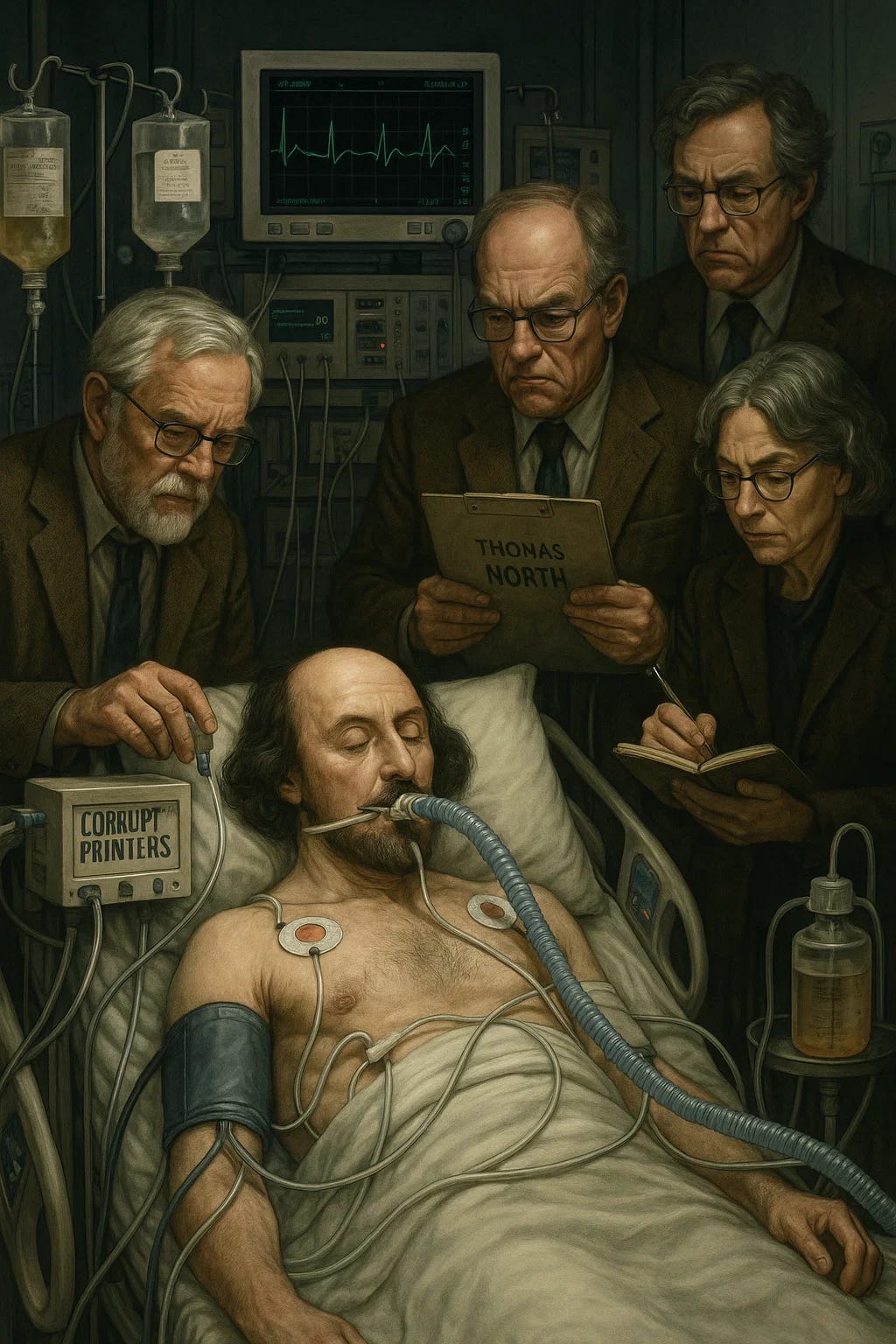
Ad hoc assumptions are the ventilators and defibrillators of a dying theory
In 1633, Galileo Galilei faced trial for his masterwork, Dialogue Concerning the Two Chief World Systems, which supported a sun-centered solar system. This was heresy on all levels. Not only did the dominant religious leaders of Italy firmly preach that the earth stood motionless at the center of the universe—so did all of Italy’s top professors and astronomers. The Roman Inquisition banned his book, forced him to recant under threat of torture, and sentenced the 70-year-old to house arrest for the rest of his life. After his forced recantation, he allegedly muttered, "E pur si muove"—"And yet it moves” —referring to the Earth’s orbiting of the sun.
How did astronomers manage to maintain the geocentric viewpoint—the hoary model developed by Claudius Ptolemy in the 2nd century AD—for more than 1500 years? They did it the same way all conventional academics have given life support to their non-responsive, clinically-dead theories: They made excuses. And with each new discrepancy or contradiction that astronomers faced, they would invent another ad-hoc rationalization.
One of the main problems with geocentrism was that the planets did not seem to orbit the Earth in perfect circles. Sometimes, they seemed to move backward (or in retrograde). To resolve this, Ptolemaic astronomers introduced epicycles—small circular orbits superimposed upon larger circular orbits. A planet would revolve around a small circle (the epicycle), which itself revolved around a larger circle (the deferent), centered near Earth.
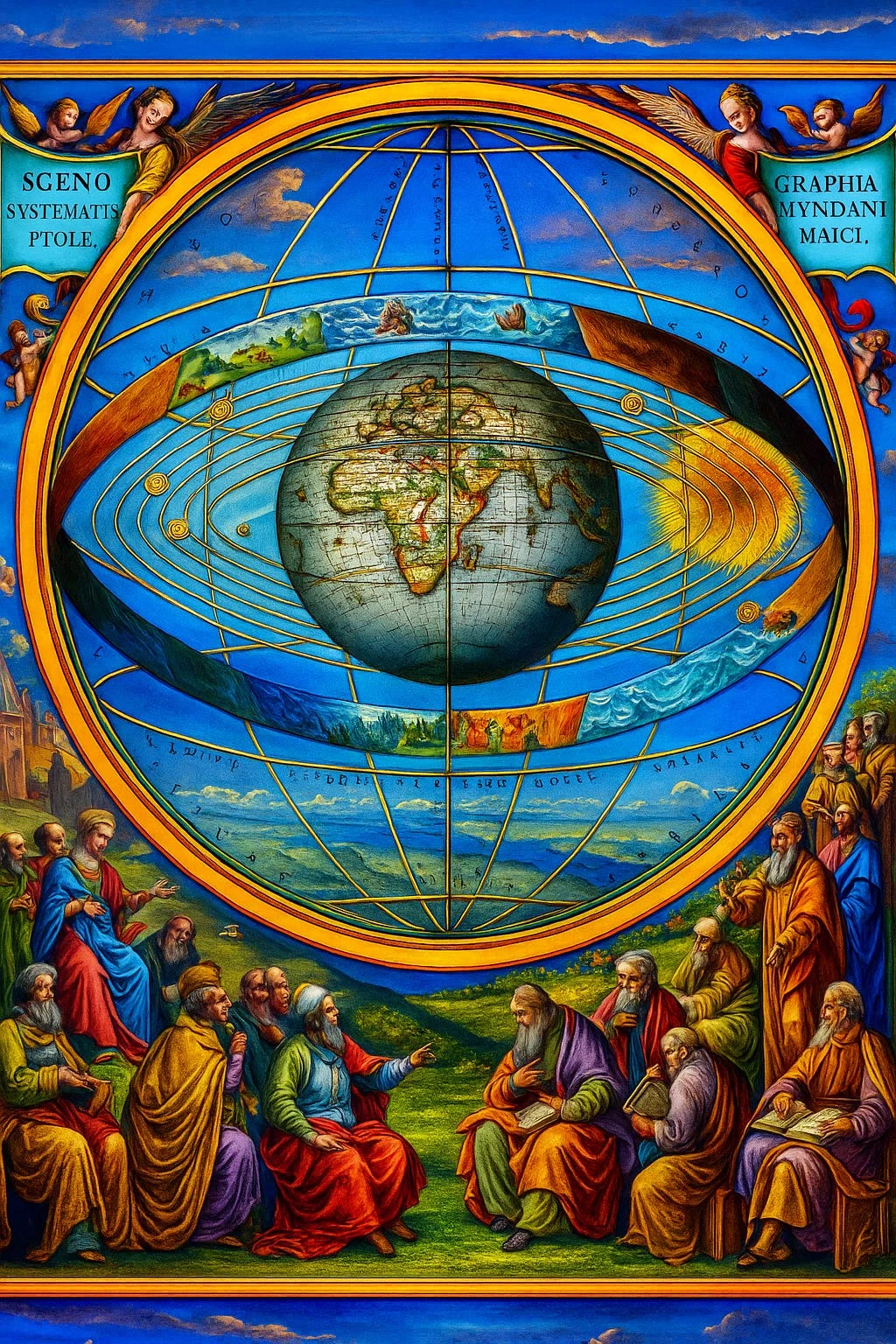
Astronomers continued adding more and more epicycles with every problematic motion in the heavens, adopting them as an impenetrable armor that protected them from threats of falsification. As observational accuracy improved, astronomers continued to add more and more epicycles to account for discrepancies, eventually creating a Rube Goldberg-like system of interlocking circles. Rather than question the foundational assumption—that Earth was the center—they patched the model with increasingly convoluted fixes.
We have seen examples of this paradigmatic inertia (to give a nod to Thomas Kuhn) throughout science history. Alfred Wegener had provided evidence for continental drift by 1912, exposing the fit of the continents and their shared geological structures and fossil taxa.

Geophysicists and geologists of the early 20th-century ridiculed the notion that continents weren’t fixed and invented new hypotheses to account for Wegener’s facts. They contended the matching outlines and geological structures were just coincidental and that the poor-dispersing fossil taxa found in multiple Gondwanan continents—like the Triassic reptilian-type creatures, Lystrosaurus and Cynognathus—just rafted across the oceans. Or perhaps they spread across the globe through the northern continents, while leaving no fossils behind. And it did not matter how many shared trans-oceanic features Wegener produced, geologists and geophysicists were willing to evoke as many rafting-hypotheses, claims of coincidence, land bridges, or missing fossils as necessary to maintain their theory.
Continental drift would not become accepted until the 1960s, 30 years after Wegener died.
Shakespeare-Scholars’ Deceitful Publishers = Geocentrism’s Epicycles
Shakespeare scholars today have adopted a similar practice, inventing complicated rationalizations to account for all the works attributed to Shakespeare while he was alive.
Here is what happened:
Shakespeare published his own adaptations while he was alive in quarto form: These include briefer, swifter, inferior staged renditions of Hamlet, Romeo and Juliet, and Henry V (all originally written by Thomas North), and other mediocre, differently styled plays like A Yorkshire Tragedy and London Prodigal that Shakespeare had written with other playwrights. (For example, Thomas Middleton is a very likely coauthor of A Yorkshire Tragedy.) These plays compose the true Stratford canon.
When the publishing syndicate of Edward Blount, William Jaggard, William Aspley, and John Smethwick decided to produce a collection of Shakespeare plays known as the First Folio (1623), they got into squabbles with the publishers who owned the rights to the Shakespeare plays that had already been published. So in many cases, they printed North’s original versions of Hamlet, Romeo and Juliet, Henry V, 2 Henry VI, 3 Henry VI, etc. which were still in the possession of Shakespeare’s theater troupe. (Click here to see why we know North wrote Shakespeare.) Indeed, the First Folio even advertised that the plays had been "Truely set forth, according to their first ORIGINALL," and the printers added special emphasis to the word "ORIGINALL," putting it in all caps and a kind of italics. (Click here for a full explanation of the First Folio.)
For centuries, scholars had studied and praised the plays of Shakespeare’s First Folio, leading them to associate the masterpieces therein with the hard-working adaptor from Stratford. It was not until the 19th-century that researchers began rediscovering the “bad quartos.” For example, Shakespeare’s rewritten, staged version of Hamlet, published in 1603, did not come to the attention of researchers until 1823, long after faith in Shakespeare’s genius had become traditional, universal, and unyielding. Researchers faced with the discovery of such lesser renditions "by William Shakespeare" found it less onerous to try to explain them away—rather than abandon their faith in “the Bard.” They never stopped to assess all the evidence as a whole, looking at all the documents “by William Shakespeare” to determine what he had really written.
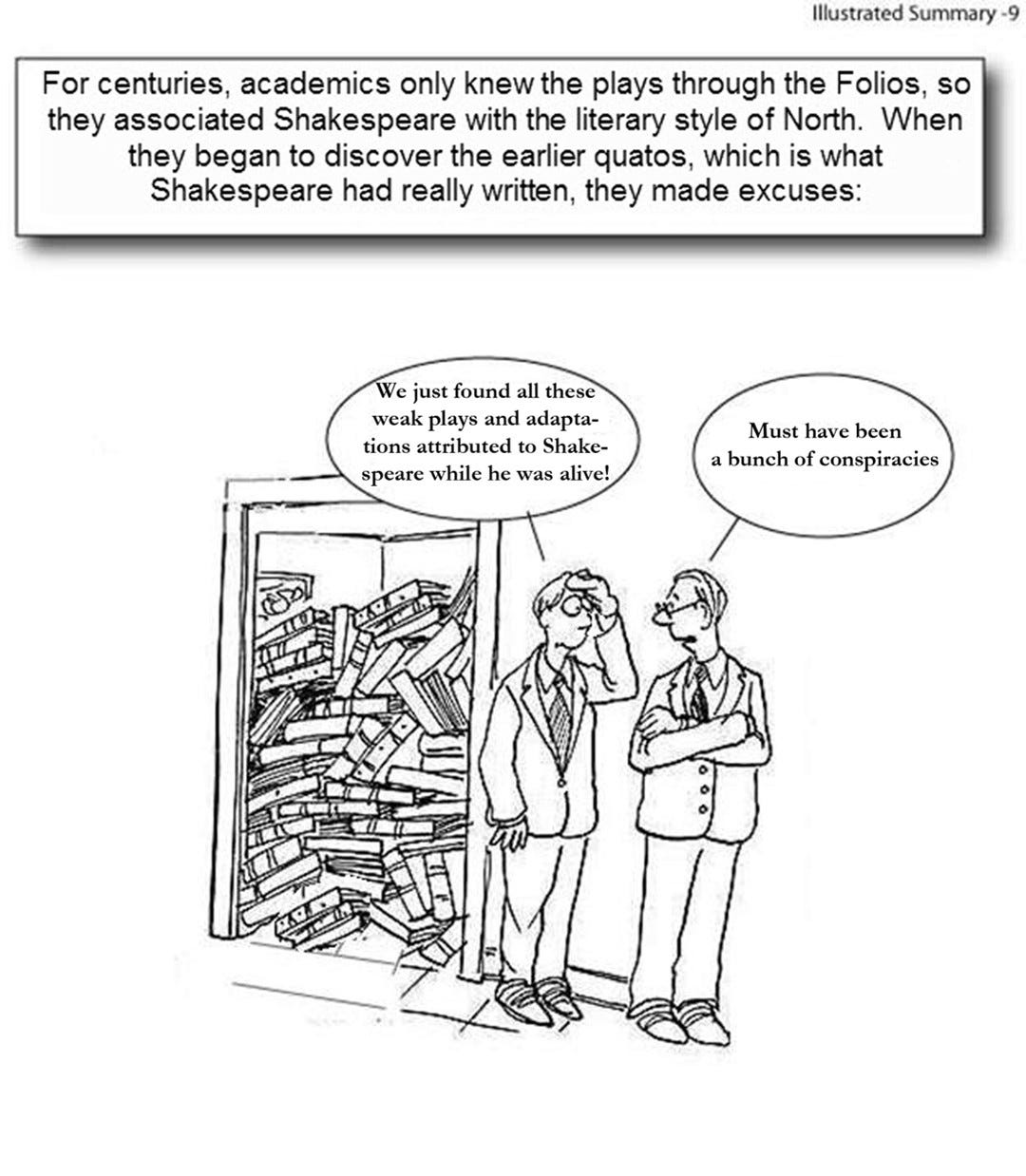
Conventional scholars also shrugged off the clear statements from contemporaries that derided Shakespeare for getting too much credit for other people’s plays (as we find in comments about Shakespeare in Groatsworth of Wit, Jonson’s On Poet Ape, etc.)
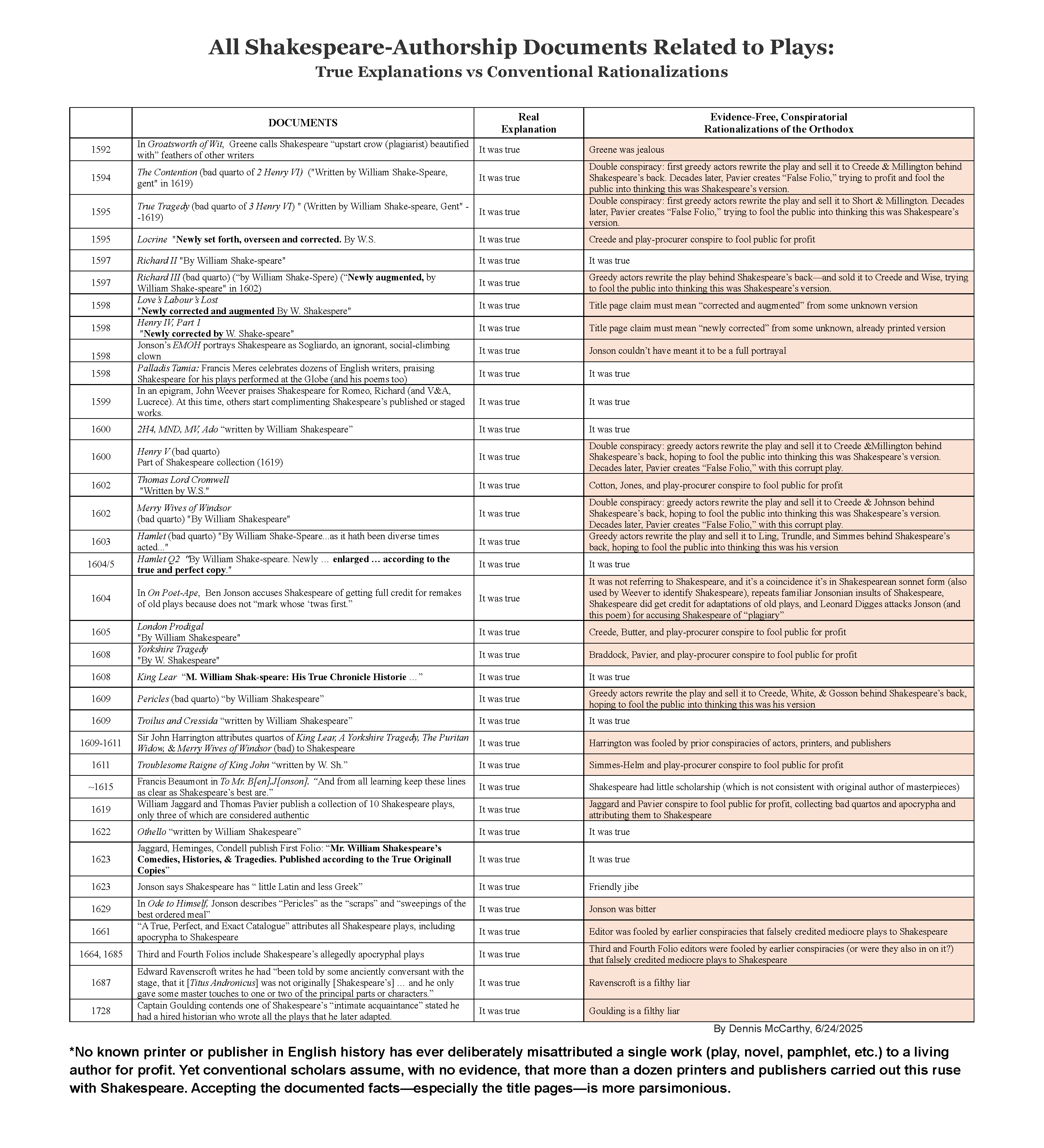
Here now is a comparison between the North-view (which accepts the straight-forward declarations of 16th- and 17th-century documents) and the conventional-view as they pertain to all documents that relate to Shakespeare’s authorship of plays. The ad hoc hypotheses, shaded in peach in the chart below, are the epicycles of Shakespeare scholarship.
In my debate with classicist Philip Womack, he pushed the orthodox view detailed above that the apocryphal plays and bad quartos were all the result of some form of piracy. And I responded with something like the following:
Can you not tell how anti-Strafordian you sound here? You think the majority of plays attributed to William Shakespeare while he was alive and up till 1621 are fraudulent and the result of corruption (this is counting all apocryphal plays and bad quartos) despite the fact that:
Shakespeare never protested about his name falsely being used.
Shakespeare and company, who performed all these plays, never complained about their illicit procurement and unauthorized publication.
No one else ever mentioned it at the time or for decades afterward.
The real authors of the apocryphal plays never demanded proper credit.
None of the dozens of printers or publishers were ever punished for it.
These nefarious printers and publishers ended up pulling off a ruse that fooled the world for a century—as scholars, editors, etc. were still referring to "Yorkshire Tragedy" and "London Prodigal" as Shakespeare's into the 18th century.
No other playwright of the Shakespeare era was similarly victimized. In fact, no other living writer in all of English history had a similar misattribution occur to him just once—let alone twelve times!
Expanding on the last point above, there is no known case in history in which an English printer or publisher has ever purposefully misattributed a single work (like a play, essay, or novel) to a single, living author whom they knew had nothing to do with the work. Why is that? Well, because the printer and publisher would know that the credited author would complain—and so too would the wronged author whose work had been stolen and assigned to someone else. In fact, as I have shown, there also may not even be an indisputable example of such a deliberate misattribution by a printer or publisher occurring to a dead author.1
There’s just no rational reason to doubt Shakespeare’s authorship of the quartos attributed to him—and no one at the time, or for even a century afterward, ever doubted those title pages either.
This is the argument—the title pages of all the Shakespeare plays—that will finally kill off this 400-year-old myth—that and all the evidence we have collected for North’s authorship.
So the fact remains: There was no wide-ranging plot to give Shakespeare false credit for The Merchant of Venice and Much Ado About Nothing as many anti-Stratfordians would believe, and there was no plot to give him false credit for True Tragedy, A Yorkshire Tragedy, Locrine, London Prodigal, Hamlet Q1, etc, as orthodox scholars would believe. These were the works attributed to Shakespeare during his lifetime; these were the works that contemporaries were referring to when they wrote about Shakespeare’s plays; these were the works that Shakespeare’s acting companies performed, and these were the works that William Shakespeare of Stratford directed, abridged, revised, organized, augmented, and hired coauthors to help craft.
And this, in turn, proves Shakespeare could not have been the original author of the masterpieces.
Finally, you are now reading a Subtack whose subscribers include the select few in the universe who accept the Shakespeare-era documents (and especially the title pages) for what they explicitly state—and do not invent evidence-free rationalizations to explain them away. And it is indisputable that this simpler view that accepts the historical documentation should be preferred.
One likely example of a work being falsely attributed to a dead author is Greene’s Groatsworth of Wit (1592), attributed to the recently deceased Robert Greene. Conventional scholars have put forth strong arguments that Thomas Nashe and Henry Chettle wrote most of the pamphlet—combining it with an unfinished work of Greene and then giving him full credit because of its controversial nature. But in this case, it wasn’t a corrupt publisher, but the authors of the work themselves who assigned it to Greene. Moreover, there were immediate, contemporaneous accusations that Chettle and Nashe were indeed the authors of the pamphlet. [Also, a careful study of Lukas Erne’s examples in the 17th century of some older works being falsely attributed to dead authors are likely all errors.]
Very good. In fairness to orthodox scholars, there was strong path-dependency here, caused mainly by the First Folio and the fact that some of the bad quartos were discovered only 200 years later.
The fact that the FF publishers put so much emphasis on the ORIGINALL plays (and avoided non-Northian plays) could still indicate (beyond legal considerations) that they wanted to honor North or the secret North-Shakespeare collaboration.
Whatever their motives, I consider the FF editors and publishers the chief culprits behind the Shakespeare confusion (in addition to Shakespeare himself, of course). They should have mentioned who wrote these ORIGINALL plays (unless North absolutely didn't want to be mentioned, or totally signed away his authorship rights, like a ghostwriter).